
Gas-Powered Drones: How Combustion Engines Extend UAV Endurance
The short answer
A gas-powered drone uses a small internal combustion engine, usually a two-stroke running gasoline and oil, instead of (or alongside) a battery pack. The reason is endurance. Liquid fuel stores dozens of times more energy per kilogram than lithium cells, so a gas-powered UAV can stay airborne for hours where a comparable electric aircraft manages well under one.
The longer answer matters more if you’re building an aircraft for survey, ISR, pipeline patrol or cargo, because the endurance gain comes with real engineering costs. Here’s how it works, where it pays off and what to plan for. If you’re already shortlisting, our range of gas UAV engines lists full specifications for each model.
Why does fuel beat batteries for long missions?
Energy density. Gasoline holds roughly 46 megajoules per kilogram, around 12,700 watt-hours. Lithium-ion cells store a few hundred watt-hours per kilogram (energy content of fuels and batteries).
~12,700 Wh/kgEnergy in gasoline
~250 Wh/kgTypical lithium-ion cell
~4 hoursGas engine on 5 kg of fuel*
~20 minElectric on 5 kg of battery*
An engine wastes most of that as heat, so the raw ratio overstates the gap. It’s still enormous.
Here’s a worked example. Picture a fixed-wing aircraft that needs 3 kW of shaft power to cruise, with 5 kg of its takeoff weight set aside for energy storage.
| Gas engine | Battery and electric motor | |
|---|---|---|
| Energy carried | 5 kg of gasoline | 5 kg of lithium-ion cells at ~250 Wh/kg = ~1,250 Wh |
| Consumption at 3 kW shaft | ~1.2 kg of fuel per hour (at 400 g/kWh) | ~3.5 kW electrical (motor and controller at ~85% efficiency) |
| Time aloft from that 5 kg | about 4 hours | about 20 minutes, before reserves |
The 400 g/kWh figure isn’t theoretical. It’s the cruise fuel consumption we publish for the GenPod 150 at 5,500 RPM. Real numbers will shift with your propeller, airframe drag and the reserve you hold back, but the order of magnitude won’t. That’s why gas powered drone flight time is quoted in hours.
Often overlooked: a gas-powered aircraft gets lighter as it flies, burning off fuel weight hour by hour. A battery weighs the same empty as it does full.
Where gas engines fit, and where they don’t
Not every drone should burn fuel. A quick inspection flight over a rooftop is a battery job: quieter, simpler, nothing to mix or spill.
Combustion engines earn their place when a mission has one or more of these:
- Long time on station. Mapping a corridor, watching a perimeter or relaying communications for a shift, not a few minutes.
- Heavy payloads. EO/IR gimbals, LiDAR, radar or cargo that eat into the weight budget you’d otherwise give to batteries.
- Long transits. Flying 50 miles to the work area before the real mission starts.
- No charging infrastructure. A field site with a fuel can but no generator bank.
Gas-powered fixed-wing drones
This is the natural home for a gas engine. A fixed-wing aircraft cruises at a steady power setting for hours, which is exactly the load a small two-stroke handles well. The engine turns the propeller directly, and an alternator on the crankshaft charges the battery and runs the avionics on the way.
Gas-powered VTOL and multirotor drones
Hovering is harder. A quadcopter steers by changing each rotor’s speed many times a second, and a piston engine can’t respond that fast through a fixed-pitch propeller. So gas VTOL designs usually take one of three routes: a helicopter layout with variable-pitch blades, a quadplane that lifts on electric motors and cruises on a gas engine, or a hybrid where the engine drives a generator and the rotors stay electric. We’ll cover the hybrid approach in its own guide.
A heavy-lift example: the DA 215 EFI
Say you’re building a large fixed-wing or quadplane platform carrying a multi-sensor payload. The propulsion engine needs real continuous power and the aircraft needs electrical power for that payload.
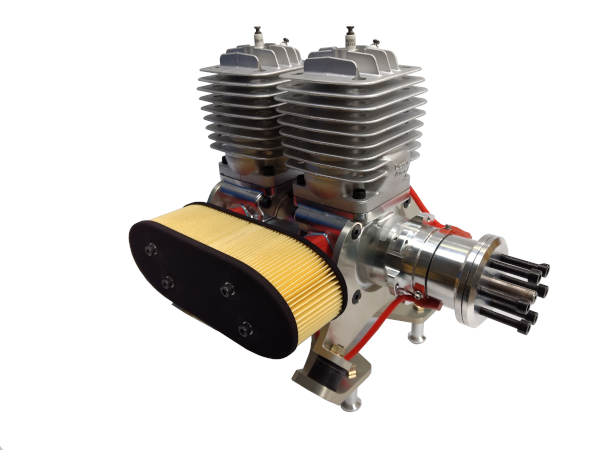
Our DA 215 EFI engine is built for that end of the range:
- Engine 215 cc two-stroke
- Power 14.9 hp (11.1 kW) continuous at 7,000 RPM
- Weight 4.94 kg (10.9 lb) with throttle body
- Fuel Any grade of pump gasoline, two-stroke oil at 40:1
- Electrical Optional 500 W starter alternator, driven directly off the crankshaft, with a power management unit and integrated starter controller for remote starting
- Tested Sea level to 10,000 ft, 10°F to 120°F
That alternator is the detail that matters for long missions. On a four-hour flight, your gimbal, datalink and flight computer can’t run off a battery alone without carrying a heavy one. A crankshaft alternator turns a little of the engine’s output into regulated DC for the whole flight.
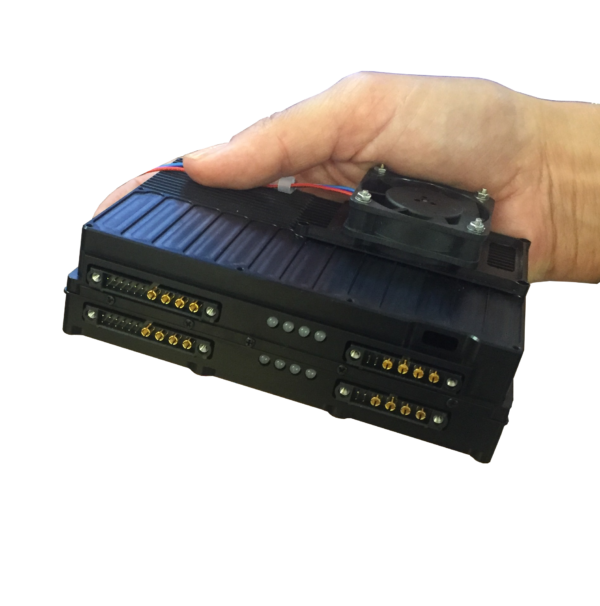
For smaller airframes, a standalone power management unit does the same job: it takes alternator input, charges two independent battery packs and feeds separate avionics, payload and servo outputs.
What you trade for endurance
A gas engine solves the endurance problem and hands you a few new ones. None are deal-breakers. All of them should be in your design review.
Vibration. A single-cylinder two-stroke shakes. Sensors and gimbals need isolation, and so does the engine mount. Our GenPod units ship with an isolated motor mount for exactly this reason.
Noise. You’ll hear a gas-powered UAV long before you see it. For some missions that’s irrelevant. For others it rules combustion out at low altitude.
Fuel logistics. Pump gasoline is easy to source for commercial work. Defense units operating where only JP-8 is stocked face a harder choice, which is why heavy-fuel propulsion exists as its own category.
Starting. Many small engines are still hand-started with a prop flip, which isn’t something you want to do on a 30 kg aircraft. Remote electric starting, like the DA 215’s starter alternator, removes the risk.
Maintenance. Engines wear. Ask for the time between overhauls before you buy: our GenPod 150 is rated at 300 hours TBO, and the MIL SPEC version of the DA 215 at 400 hours. A maintenance contract turns overhauls into a schedule rather than a grounded aircraft.
Altitude and temperature. Air gets thinner as you climb, and a carburetor’s mixture drifts with it. Electronic fuel injection corrects for altitude and cylinder head temperature automatically, which is one reason every DA and GenPod engine we build uses EFI.
Swapping engines in minutes
For a fleet flying every day, the bigger cost is often downtime rather than the engine itself. When a conventionally installed engine is due for service, the aircraft sits in the hangar.
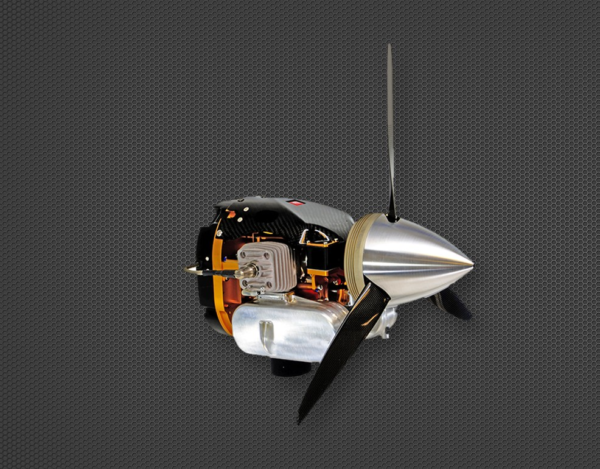
GenPod propulsion units were designed around that problem. Each one packages the engine, EFI system, ignition, fuel pump, electronics and a built-in starter-generator into a single line-replaceable unit on a quick-mount interface.
You connect power, connect the fuel tank and provide a throttle input; the engine starts on a simple 5 V signal. The GenPod 150 delivers 9.37 hp continuous and up to 500 W of electrical power for the avionics, at 8.33 kg (18.37 lb) for the complete system with mufflers.
An operator with one spare pod can pull a unit at its overhaul interval, bolt in the replacement and fly the same day.
Choosing a gas engine for your drone
Start with the mission, not the engine. Work out the continuous shaft power at your maximum takeoff weight and highest density altitude, add your electrical load, and settle the fuel question before you look at spec sheets. Our guide on how to choose a UAV engine walks through that checklist step by step, including installed weight and test envelopes.
Frequently Asked Questions
How long can a gas-powered drone fly?
Typically hours rather than minutes. Flight time depends on fuel capacity, engine fuel consumption and the power the airframe needs to cruise. As a rough illustration, an aircraft cruising on 3 kW of shaft power at 400 g/kWh burns about 1.2 kg of fuel an hour, so 5 kg of fuel gives around four hours before reserves.
Are gas-powered drones better than electric drones?
For long-endurance and heavy-payload missions, usually yes, because gasoline stores far more energy per kilogram than batteries. For short flights, low-altitude inspection or anywhere noise matters, electric drones are simpler, quieter and need less maintenance.
What fuel do gas-powered drones use?
Most small UAV engines are two-strokes running pump gasoline mixed with two-stroke oil. Our DA 215 EFI, for example, runs on any grade of pump gasoline at a 40:1 oil ratio. Military operators that need JP-8 or Jet A use engines built specifically for heavy fuel.
Do gas-powered drones still need a battery?
Yes. The engine’s fuel injection electronics need power to start and run, and most aircraft carry a battery for the flight computer and as backup. On longer flights an alternator driven by the engine recharges that battery and powers the avionics and payload.
Can a quadcopter run on a gas engine?
Not directly with fixed-pitch rotors, because a piston engine can’t change speed fast enough to stabilize a multirotor. Gas-powered VTOL drones use a helicopter-style rotor with variable pitch, a quadplane layout that lifts electrically and cruises on the engine, or a hybrid system where the engine drives a generator.
Talk to us about your aircraft
Tell us your airframe weight, mission profile, fuel requirement and electrical load, and we’ll recommend an engine, alternator and power management setup that fits. HFE International has designed and built fuel-injected UAV engines in Tucson, Arizona since 2010, with more than 2,000 engines, GenPods and accessories in use across 28 countries. Browse our gas UAV engines or contact our engineering team.
*Illustrative figures from the worked example above, before reserves. Specifications are taken from hfe.aero product pages as of October 2026 and may change. Confirm current specifications and configuration with HFE International before purchase.
