
How to Choose a UAV Engine: A Buyer’s Guide for Integrators
Choosing a drone engine comes down to five questions, in this order: what fuel your operation can supply, how much shaft and electrical power the mission needs, what the engine weighs once it’s fully installed, what environment it has to survive, and how you’ll maintain it. Get the order right and the shortlist writes itself.
Most buyers start with horsepower. That’s backwards. We’ve built fuel-injected engines for unmanned aircraft in Tucson since 2010, and the programs that struggle usually picked an engine off a spec sheet before they’d settled their fuel supply and electrical load. This guide is the checklist we’d hand a new integrator on day one. If you already know your numbers, you can compare our UAV engines for sale with full specifications.
The short answer
- Fuel: what your operation can actually supply, gasoline or JP-8.
- Power: continuous shaft power at your worst-case density altitude, plus your electrical load.
- Weight: the installed system, not the bare engine.
- Envelope: the altitude and temperature range the engine was tested to.
- Maintenance: time between overhauls, and how fast you can swap an engine.
1. Start with fuel, not power
Fuel is the one decision you can’t fix later.
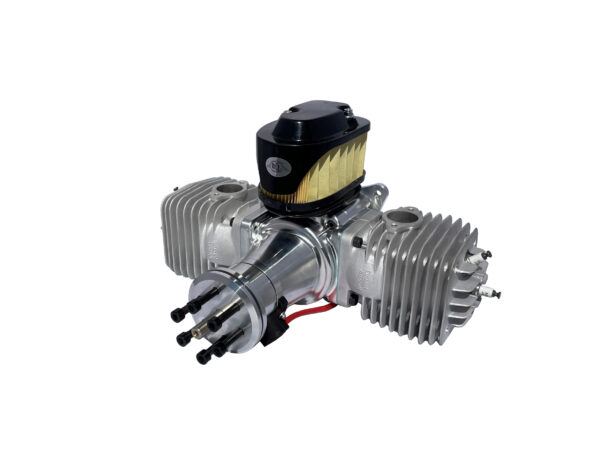
For commercial and industrial operators the answer is usually simple. A two-stroke UAV engine running pump gasoline and oil is easy to supply almost anywhere. Our DA 215 EFI, for example, runs on any grade of pump gasoline with two-stroke oil mixed at 40:1.
Defense programs are different. Under the Department of Defense single fuel policy, JP-8 is the primary fuel for land-based air and ground forces overseas. If your aircraft will fly from a forward site where the only fuel on the truck is JP-8, a gasoline engine means running a separate supply chain for one small platform. Some units accept that. Many don’t.
Engines built for heavy-fuel propulsion remove that problem, but the range of options is narrower and the engine choice follows from the fuel, not the other way round. If JP-8 or Jet A is a hard requirement, say so in your first conversation with any supplier.
2. Why use a combustion engine at all?
Endurance. Liquid fuel holds far more energy per kilogram than any battery you can fly today. Gasoline carries roughly 46 megajoules per kilogram, around 12,700 watt-hours, while lithium-ion cells store a few hundred watt-hours per kilogram (energy content of fuels and batteries).
An engine only turns part of that into shaft power, so the real-world gap is smaller than the raw numbers suggest. For missions measured in minutes, batteries are simpler. For missions measured in hours, with a heavy payload or a long transit to station, a gas engine is usually the only way to close the mission. That’s why most long-endurance fixed-wing and heavy-lift VTOL platforms carry one. Our guide to gas-powered drones works through the flight time math in detail.
3. Size the engine for the whole power budget
There are two loads to cover, and integrators often size for only one.
The first is propulsion: the shaft power your propeller needs to climb, cruise and hold station at your maximum takeoff weight, at the highest density altitude you’ll operate in. The second is electrical. Your payload, datalink, flight computer and servos all draw power, and on a multi-hour flight that power has to come from an alternator, not a battery.
Here’s how part of our range compares on rated output:
| Engine | Displacement | Rated power | Weight as listed |
|---|---|---|---|
| DA 35 EFI | 35 cc | 2.8 hp (2.1 kW) | 1 kg (2.2 lb), engine with intake |
| DA 100 EFI | 100 cc | 7.4 hp (5.5 kW) | 2.5 kg (5.57 lb), engine with intake |
| GenPod 150 LRU | 151 cc | 9.37 hp continuous at 6,000 RPM | 18.37 lb, complete system |
| DA 215 EFI | 215 cc | 14.9 hp (11.1 kW) continuous at 7,000 RPM | 4.94 kg (10.9 lb), engine with throttle body |
Two things in that table catch people out.
First, continuous and peak ratings aren’t the same number. The GenPod 150 makes 10.3 hp at peak but is rated at 9.37 hp continuous. Your aircraft cruises on the continuous figure, so size to that and treat peak as climb margin. Ask every supplier which number they’re quoting, and at what RPM.
Rule of thumb: size the engine to its continuous rating at your highest density altitude. Peak power is climb margin, not cruise power.
Second, the weights aren’t like for like. One row is a complete system and the others are bare engines. That leads straight to the next question.
4. Weigh the installed system, not the bare engine
A bare engine weight is the lightest number on any spec sheet. It’s rarely what you’ll actually fly.
Take the DA 100 EFI. The engine with intake weighs 2.5 kg. Add the ECM (98 g), the fuel pump (150 g), the muffler (275 g) and the 500 W alternator system (2.49 kg), and you’re at about 5.5 kg before wiring, mounts and the small LiPo battery that powers the ECU. The alternator alone weighs nearly as much as the engine.
Now a scenario. Say your EO/IR gimbal, datalink and flight computer draw 350 W in cruise. A 500 W alternator covers that with margin, and the 2.49 kg it adds is the price of not carrying a large battery. Size the alternator too small and you’re back to batteries. Size it too large and you’re flying dead weight on every sortie.
So build your weight budget from the installed figure. If a supplier can’t give you one, that’s a useful answer in itself.

5. EFI or carburetor?
For most UAV work, fuel injection is the better choice, and it’s what every engine in our EFI UAV engines range uses.
A carburetor meters fuel from the pressure of the air flowing through it, so its mixture drifts as air density changes with altitude and temperature. An electronic fuel injection system reads its sensors and adjusts the fuel delivered as conditions change. Ours corrects for altitude and cylinder head temperature automatically, with overheat protection and onboard data logging built in (see the DA 215 EFI specifications). In practice that means more consistent starting, a steadier mixture across your operating envelope, and an ECU that can log what the engine was doing when something went wrong. Our ECU has been in production for more than 25 years, refined across that time, and has the functionality needed to control a heavy-fuel engine.
| Carburetor | Electronic fuel injection | |
|---|---|---|
| Mixture as altitude and temperature change | Drifts with air density | Corrected automatically |
| Starting | Less consistent | More consistent |
| Engine data | None | Onboard logging and telemetry |
| Cost and complexity | Lower | Higher |
Carburetors still have a place. They’re cheaper and simpler, and for a low-altitude aircraft flying in a narrow temperature band they can be perfectly adequate.
6. Match the engine to your operating envelope
Every engine is tested over a defined altitude and temperature range. Read that range before you read the power figure.
Our standard DA 100 EFI fuel system was tested from sea level to 10,000 ft and from 10°F to 120°F. The DA 35 EFI was tested from sea level to 10,000 ft and from 32°F to 120°F. That covers a lot of commercial work. It doesn’t cover a high-altitude mission or a winter deployment.
That’s where the MIL-SPEC variants come in. The DA 100 EFI MIL SPEC followed the test methods of MIL-STD-810, working through the majority of the laboratory methods in the standard. Its fuel injection system was tested to 20,000 ft and from -10°F to 120°F, and it has been in service on more than 700 aircraft with over 67,000 flight hours.

20,000 ftfuel system test altitude
-10°F to 120°Ftest temperature range
700+aircraft in service
67,000+flight hours
The MIL-SPEC version costs more. At the time of writing the DA 100 EFI lists from $11,900 and the DA 100 EFI MIL SPEC from $23,017, both depending on configuration. If your mission sits inside the standard envelope, you don’t need to pay for the wider one. If it doesn’t, the cheaper engine is the expensive mistake.
7. Plan for maintenance from day one
Ask about time between overhauls (TBO) before you ask about price. A cheaper engine with a short TBO can cost more per flight hour than a dearer one that stays on the wing longer. The GenPod 150, for example, is rated at 300 hours TBO.
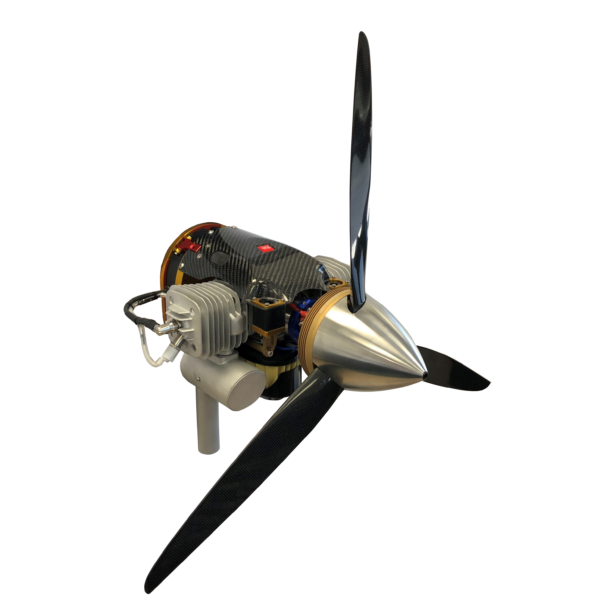
Then think about what happens when an engine does come off the aircraft. With a conventional installation, the aircraft is grounded until the engine is serviced and refitted. Our GenPod line-replaceable units package the engine, EFI system, ignition, fuel pump, electronics and isolated motor mount into one unit with a quick-mount interface. You plug in power, connect the fuel tank and provide a throttle input; the engine starts on a simple 5 V signal. A fleet that keeps a spare pod can swap engines in minutes and keep flying while the other unit is serviced.
For larger fleets, a maintenance contract turns overhaul timing into a schedule rather than a surprise.
8. Test before you commit
Spec sheets are a starting point. Your propeller, cowling, exhaust routing and airflow will change how an engine performs in your airframe.
Before you lock the design, put the engine on a dyno. Our dyno testing service produces a power curve, fuel consumption figures and industry-standard corrected power curve reports, and we use the same lab to calibrate and fine-tune fuel injection systems. Thermal chamber testing and mobile engine testing at your facility are also available as part of our engine testing and integration support. We’ll also troubleshoot engines we didn’t design.
Questions to ask any drone engine manufacturer
Take this list into every supplier conversation:
- Is the power figure continuous or peak, and at what RPM?
- What’s the installed weight with alternator, ECU, fuel pump, muffler and harness?
- How much electrical power does the alternator deliver, and at what voltage?
- What altitude and temperature range was the engine tested to? Can we see the data?
- Which fuels is it approved for?
- What’s the TBO, and who performs the overhaul?
- Can we get dyno data for our specific unit?
- What are the lead times for engines and spares?
A good supplier answers all eight without hesitation.

What does a UAV engine cost?
It depends heavily on configuration: the alternator, muffler and starter options can move the price by several thousand dollars on the same engine. As listed on our site at the time of writing, our standard DA EFI engines range from about $7,650 for a DA 35 EFI to about $20,800 for a fully configured DA 215 EFI. MIL-SPEC variants range from about $18,300 to $30,400, and GenPod units from about $24,650 to $26,100.
Frequently Asked Questions
What is the best engine for a drone?
There’s no single best drone engine. The right one depends on the fuel you can supply, the continuous shaft and electrical power your mission needs, the installed weight your airframe can carry, and the altitude and temperature you’ll fly in. Settle those four first, then compare engines that meet all of them.
How much horsepower does a UAV engine need?
Enough continuous power to fly your aircraft at maximum takeoff weight at the highest density altitude you’ll operate in, plus margin for climb, plus whatever your alternator draws. Small fixed-wing and VTOL UAVs commonly use engines from a few horsepower up to around 15 hp. Our DA EFI range runs from 2.8 hp to 14.9 hp.
Can a drone engine run on JP-8?
Some can, but most small two-stroke UAV engines are designed for gasoline mixed with two-stroke oil. Engines that run on JP-8 or Jet A are built or converted specifically for heavy fuel. If your operation only stocks JP-8, make it a hard requirement from the start.
How long does a UAV engine last between overhauls?
It varies by engine and how it’s operated. Ask each supplier for the rated time between overhauls (TBO) and what the overhaul includes. As one example, our GenPod 150 LRU is rated at 300 hours TBO.
Who manufactures UAV engines in the United States?
HFE International designs and manufactures fuel-injected UAV engines, GenPod propulsion units and engine accessories in Tucson, Arizona, and has done since 2010. We’re AS9100D and ISO 9001:2015 certified and have delivered more than 2,000 engines, GenPods and accessories, now in use in 28 countries.
Talk to us about your aircraft
Send us your airframe weight, mission profile, fuel requirement and electrical load, and we’ll recommend an engine and alternator combination that fits. You can browse our UAV engines for sale or contact our engineering team directly.
Specifications and prices are taken from hfe.aero product pages as of October 2026 and may change. Confirm current specifications, configuration and pricing with HFE International before purchase.
